



The AI Pilot Worked. So Why Is It Not in Production?
The demo worked. The model delivered promising results. The leadership team could see the potential.
Then reality arrived.
Could it connect to the systems already in place? Was the underlying data reliable enough? Who would own it once it went live? Would security and compliance approve it? Could employees use it in their day-to-day work? And, most importantly, could the organisation prove its value beyond the pilot?
The challenge was no longer whether the AI worked, but whether the organisation was ready to use it in practice.
Many initiatives stall here. A pilot proves potential, but production brings users, risks and consequences. Closing the gap requires a business case, trusted data, secure foundations, operational discipline and people ready to use AI.
Why Successful Pilots Get Stuck
A pilot usually operates in favourable conditions. The data has been prepared, the number of users is limited and a specialist team is available to review outputs, correct errors and resolve exceptions.
Production removes that safety net.
The solution must now work with live data, connect with existing systems and support people across different teams. An issue that was manageable during testing can quickly affect customer experiences, operational decisions or regulatory obligations.
Moving into production is therefore not simply the next technical phase. At TMotions, we assess readiness across five connected areas: business value, ownership, data, governance and adoption. Reviewing these areas early helps organisations identify gaps before they become costly deployment problems.
The Pilot to Production Gap
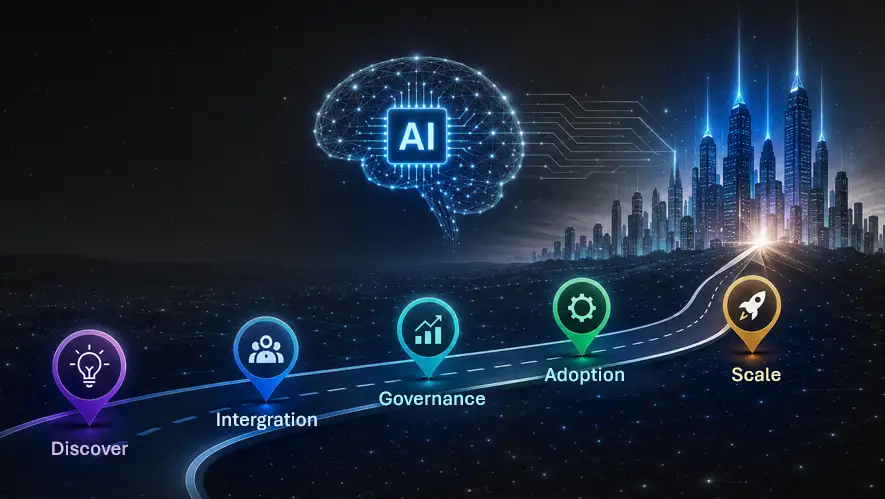
The journey from pilot to production is not a single technical step. It is a series of readiness checks.
The further an AI initiative moves into the organisation, the more it has to work with real data, real systems, real users and real business consequences.
That is why taking AI into production is not simply about making the technology bigger. It is about making everything around it ready to support real world use.
A useful way to think about the journey is:

1. Start With the Business Problem
A pilot may deliver impressive technical results without proving that it will improve a meaningful business outcome.
For example, a customer service assistant might generate accurate responses during testing. But will it reduce handling time, improve first-contact resolution or help employees manage more complex enquiries? Unless the organisation defines that outcome, it cannot judge whether the solution is worth deploying.
Success measures should be agreed before development moves too far. These should include the current performance baseline, the expected improvement, the cost of implementation and the timeframe in which value should become visible. This gives leaders a clearer basis for deciding whether to scale, refine or stop the initiative.
2. Establish Ownership Beyond the Pilot Team
The moment an AI solution enters a live business process, ownership becomes more complicated.
Someone must approve access to data. Someone must manage integration with existing systems. Someone must respond when an output is inaccurate, and someone must remain accountable for the business decision influenced by it.
These responsibilities cannot sit entirely with an innovation or data science team. Business leaders, IT, security, compliance, data and operations all need to be involved early enough to shape the solution. Otherwise, questions that should have guided the pilot become obstacles at the point of deployment.
This does not always require a large AI Centre of Excellence. It does require a named business owner, clear decision-making authority and an agreed process for managing risk, performance and change.
AI readiness assessments often surface these gaps while they are still manageable. A pilot may have a technical owner, for example, but no business leader accountable for its performance once it becomes part of daily operations.
3. Build a Data Foundation You Can Trust
In production, data quality becomes visible immediately. Duplicate customer records, missing fields and inconsistent definitions stop being technical issues; they begin to affect business decisions.
A forecasting model may perform well in a pilot using spreadsheets prepared by analysts each Friday. In production, it needs an automated feed from the ERP system, shared data definitions across Finance and Sales, and controls that flag missing or delayed information before it affects the forecast.
Before deployment, organisations need to know where the data comes from, who owns it, how frequently it changes and which users or systems can access it. They also need agreed quality standards and a way to identify when the data falls below them.
The objective is not to gather as much information as possible. It is to provide the solution with relevant, consistent and properly governed data that reflects the conditions it will encounter in daily use.
4. Put Enterprise Governance Into the System
Governance becomes credible when it is reflected in the way the solution operates, not simply recorded in a policy.
Role-based access controls should determine who can view sensitive information, change system settings or approve a deployment. Audit trails should record which data was used, what the system produced and who reviewed or acted on the output.
For higher-impact decisions, such as those affecting customers, employees, eligibility or financial outcomes, human approval should be built into the process. The organisation should also monitor outputs over time to identify declining accuracy, unexpected behaviour or changes caused by new data and business conditions.
Clear escalation procedures are equally important. Employees need to know what to do when an output appears incorrect, potentially harmful or outside the system’s intended use.
These controls allow an organisation to answer practical questions about accountability: who had access, what happened, who approved it and what action was taken. That visibility helps teams use AI with greater confidence while maintaining appropriate oversight.
5. Prepare for the Day After Launch
Once the solution is live, the work changes rather than ends.
Data patterns shift, customer behaviour evolves and business rules are updated. A system that performed well at launch may become less reliable if these changes are not identified and addressed. Teams therefore need processes for monitoring performance, reviewing feedback, managing updates and responding when outputs fall outside agreed limits.
Employees also need more than a product demonstration. They should understand how the tool supports their role, what they remain responsible for and when human judgement must take priority. Managers need to reinforce these expectations through training, guidance and regular review.
Adoption depends on whether the technology works within the reality of someone’s working day. If it creates extra steps, produces unreliable answers or leaves accountability unclear, people will find ways around it. A production-ready solution must therefore work operationally as well as technically.
From Experimentation to Enterprise Capability
Moving AI into production requires more than a successful pilot. Organisations must ensure that the supporting data, systems, governance, processes and teams are ready to manage AI effectively in day-to-day operations.
Success depends on identifying which use cases offer genuine business value, understanding what must be addressed before deployment and establishing clear ownership once the technology is in use. This allows organisations to develop AI solutions that remain reliable, secure and effective beyond the initial testing stage.
AI value is not created at the pilot stage. It is created when the solution becomes part of everyday business operations.
TMotions helps organisations assess AI readiness, strengthen the foundations for production and build a practical roadmap for scaling AI across the enterprise.
Ready to move beyond AI experimentation? Let’s evaluate what’s standing between your pilot and production and build a roadmap to close that gap.